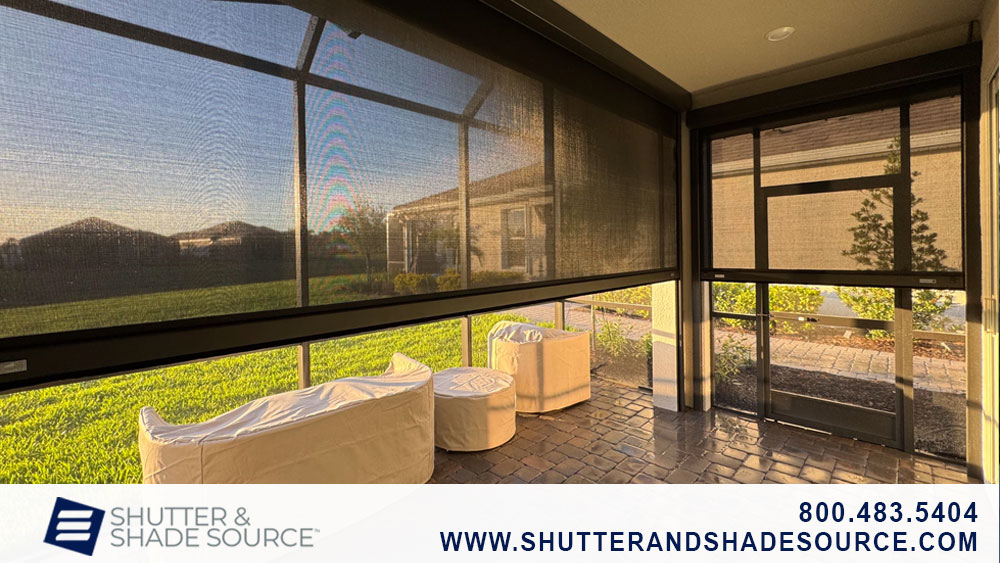
A homeowner at Esplanade at Azario Lakewood Ranch installed two motorized MagnaTrack hurricane screens to get more time outside without giving up storm, sun, wind, or insect protection. The screens — Florida Product Approval FL 30798, black mesh on bronze track — cover a 156″ x 120″ west-facing opening and a 74″ x 108″ north-facing opening, closing the patio with one switch while keeping the backyard view intact.
More time outside. That’s what most homeowners actually want when they call us. Not another feature to manage, not another maintenance headache — just a patio they can use more often, in more weather, without worrying about what’s coming through the screen door.
That was the request from a homeowner at Esplanade at Azario Lakewood Ranch last week. Beautiful lanai, open sight-lines to the backyard, and a patio that sat underused whenever the sun got too strong, the wind picked up, or the mosquitoes showed up uninvited. The fix wasn’t a bigger structure or a full enclosure. It was two motorized MagnaTrack hurricane screens, installed to close off the space on command and open it back up just as fast.
What problem were these MagnaTrack screens solving?
A common assumption: if you want storm protection, you have to sacrifice your view. With MagnaTrack, that’s not the case.
The homeowner wasn’t choosing between safety and a usable patio. They wanted both — protection from storms, sun, wind, and insects, and an unobstructed look at the yard when the screens weren’t needed. One switch handles the transition. Full protection goes up or down in seconds, and the backyard view stays intact either way.
That’s the core job these screens do. They turn a seasonal patio into a space that works in more conditions, more often, without asking the homeowner to trade one benefit for another.
What was actually installed at Esplanade at Azario Lakewood Ranch?
Two motorized MagnaTrack hurricane screens went in, mounted inside the patio:
- One screen measuring 156″ x 120″, facing west
- One screen measuring 74″ x 108″, facing north
Both carry Florida Product Approval FL 30798, the state’s certification confirming the system meets Florida’s wind-load and impact standards for hurricane-rated screens. The screens themselves are black mesh, running on bronze-colored track — a pairing chosen to blend with the home’s existing finishes rather than stand out against them.
Two Hurricane screens, two directions, one coordinated system. That’s a deliberate choice, not a default. Covering a west-facing opening and a north-facing opening separately means each screen responds to the specific sun angle, wind exposure, and sightline on that side of the patio — rather than forcing one oversized screen to do a job it wasn’t sized for.
Why does screen color and track color matter beyond looks?
Color isn’t just an aesthetic decision — it affects how much the screen fades into the background of the home versus calling attention to itself.
Black mesh does two things well: it holds up visually against a variety of exterior palettes, and it keeps the view through the screen as clear as possible compared to lighter mesh colors. Bronze track complements black mesh without competing with trim, railings, or window frames nearby. On this project, the color pairing was selected so the screens read as part of the patio’s architecture, not an add-on.
How does a motorized hurricane screen protect against storms, sun, wind, and insects at the same time?
One screen system, four jobs. Here’s how each one works.
Storm protection. The screens carry Florida Product Approval FL 30798, meaning they’re rated to perform under Florida’s wind-load requirements — not just marketed as storm-ready, but certified for it.
Solar Screen control. Lowering the screen cuts direct sun exposure on the patio, reducing glare and heat without closing off the space entirely.
Wind control. A closed screen blocks wind-driven debris and reduces the gusts that make an open patio uncomfortable on breezy days.
Insect protection. The mesh keeps mosquitoes, no-see-ums, and other insects out, so the patio stays usable at dusk and after dark — prime bug season in Florida.
Four problems, one system, one switch. That’s the practical value: the homeowner isn’t operating four different solutions for four different conditions. They’re operating one screen.
Choose motorized screens over manual ones if ease of use matters more than upfront cost
Manual screens cost less upfront. Motorized screens cost more — but they close in seconds, operate with one switch, and don’t require anyone to wrestle a crank or track by hand.
Choose motorized if you want the screen used consistently, not just when someone has the energy to deploy it manually. Choose manual if budget is the primary constraint and the screen will see occasional, planned use rather than daily operation. For a patio like this one — used often, exposed on two sides, and meant to respond quickly to changing weather — motorized made the practical difference.
What this means for your own patio or lanai
Every outdoor space has its own exposure. A west-facing opening deals with afternoon sun and prevailing winds. A north-facing opening handles different conditions entirely. Sizing and positioning screens around those specifics — rather than installing one generic configuration — is what makes the difference between a screen that gets used daily and one that gets ignored.
If your patio sits empty more often than you’d like because of sun, wind, bugs, or storm worries, the fix isn’t necessarily a bigger renovation. It might be two screens, sized correctly, controlled by one switch.
Some Frequently Asked Questions
How much does a motorized MagnaTrack screen installation cost?
Cost depends on the number of screens, their size, and site-specific factors like mounting conditions. A two-screen installation sized to match individual openings. One 156″ x 120″ and one 74″ x 108″ screens installed at Esplanade at Azario Lakewood Ranch. Contact MagnaTrack for a quote specific to your patio’s dimensions.
How long does installation take?
A two-screen residential installation, such as this one, is typically completed within a single day once the screens are manufactured and delivered to the site.
Do motorized screens require much maintenance?
Motorized track systems are built to operate with minimal upkeep. Routine care — keeping the track clear of debris — is the main maintenance requirement for most homeowners.
What’s the alternative to motorized hurricane screens for patio protection?
Alternatives include manual crank screens, removable storm panels, or full enclosures. If you choose manual screens if upfront cost matters more than daily convenience. Choose a full enclosure if you want permanent, always-on protection rather than an adjustable system. Choose motorized screens, like the ones installed here, if you want fast, one-switch control over sun, wind, insects, and storm protection without sacrificing your view.
Get more use out of your own outdoor space
A patio that only works in perfect weather isn’t doing its job. The homeowner at Esplanade at Azario Lakewood Ranch now has a space that handles sun, wind, storms, and bugs. All from one switch, with the backyard view still intact.
If your patio or lanai sits underused for the same reasons, talk to MagnaTrack about sizing screens to your specific openings and exposure. The right configuration turns an occasional-use space into one you’ll actually use.
Request an onsite consultation with Shutter & Shade Source and find out which system fits your space.
Call 800.483.5404 or Click this link to schedule your onsite consultation
Shutter & Shade Source is a family run company. Learning and meeting the needs of residents and business owners all along the west coast of Florida. Find us on your favorite social media, and join our family. Facebook | Instagram | LinkedIn
